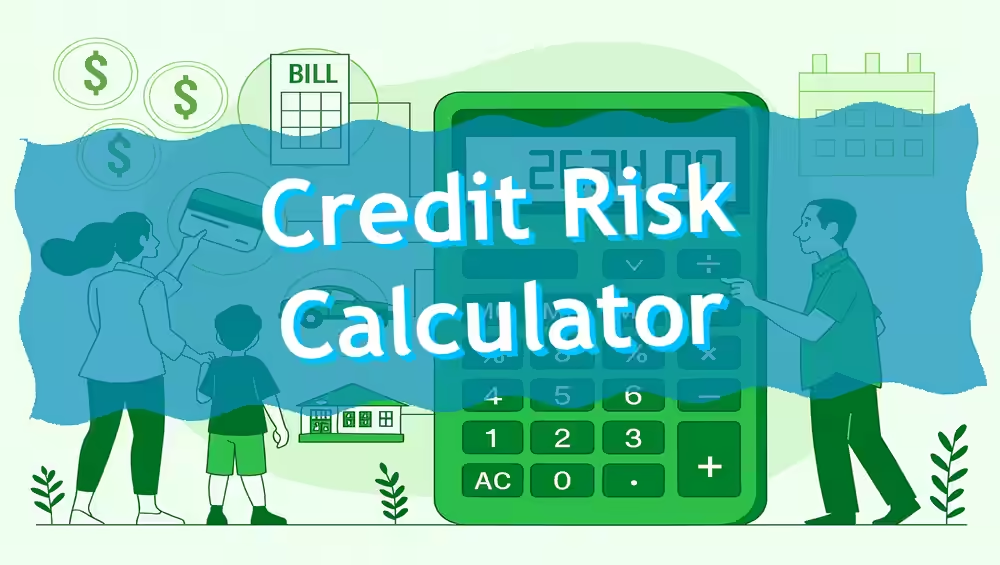
The Credit Risk Calculator can help lenders, treasurers, and portfolio managers work out how likely a borrower is to fail, how much money they would lose if they did, and how much money they would lose in different situations, products, and borrowers. I use a structured calculator since discussing about credit may turn heated very quickly. A clear framework translates statistics into things like financials, behavior, collateral, covenants, and macro signals that enable underwriters and monitors make informed choices. Discover how the credit risk calculator simplifies complex calculations for better insights.
The calculator enables you enter a number of different kinds of information, like financial ratios, bureau statistics, transaction records, sector indexes, and qualitative overrides with governance. This is because data isn’t always the same. Every input goes into the probability and severity views, and the tool makes sure that modifications are clear so that judgment doesn’t get lost under overrides that can’t be explained and show up in audits or reviews.
Define Credit Risk
Credit risk is the potential that you will lose money if a borrower or partner doesn’t follow through on their end of the arrangement. It covers the possibility of default, the amount of the loss, and the risk at the time of default. The Credit Risk Calculator breaks them down into three groups: the chance of default (PD), the loss if default happens (LGD), and the exposure if default happens (EAD). This makes it easier to figure out how much money will be lost.
Credit risk management also keeps a watch on unexpected loss, which is when people’s expectations shift. How unstable things are affects how much money you require and how much risk you’re willing to take. The calculator can handle stress multipliers and focus add-ons because real portfolios aren’t often as neat and separate as simple, static spreadsheets make them look.
It is crucial that the framework is open since credit can come in numerous forms, like loans, bonds, leases, and trade receivables. The Credit Risk Calculator keeps the fundamental ideas the same, but it enables you adjust factors like the types of collateral, the seniority, the covenants, and the amortization structures, all of which have a huge effect on recovery and time.
Examples of Credit Risk Calculator
A portfolio of corporate bonds considers about downgrades while the economy is in a slight recession. The calculator modifies LGD to reflect less market liquidity and shifts PD using transition vectors. As predicted losses and concentration costs rise, so do capital needs. The manager cuts back on inferior credits and adds “dry powder” for future chances in a calm and logical approach.
It looks like debt is becoming worse in some places, according to a mortgage book. The Credit Risk Calculator modifies PD depending on the loan-to-value bands and the degree of unemployment. On the other hand, LGD rises as home sales slow down. Provisions are better coordinated, and service teams focus on reaching out early. This cuts down on overall losses by a large amount compared to passive alternatives.
A fintech lending tool keeps track of people who borrow money more than once. Good payers’ behavior-based PD falls lower, while LGD improves better with flexible payment options and changing restrictions. The calculator shows a lower predicted loss and growth with restrictions, which keeps growth from getting out of hand when acquisitions get exciting.
How does Credit Risk Calculator Works?
The Credit Risk Calculator uses information about the debtor and the facility to come up with estimates of PD, LGD, and EAD and then figures out how much money will be lost. It uses scorecards, logistic regressions, expert rules, and hybrid methods, and it has a way to keep track of why things are done and how well they are performing. Outputs are supplied to dashboards for pricing, limits, and monitoring so that decisions can be made in a clear and consistent way.
It can also handle stress and sensitivity tests. You can raise PD by one notch, LGD for weaker collateral markets, and EAD to peak draws. The calculator shows the estimated loss and capital for each case. This means that risk appetite and provisioning can show realistic ranges instead of just one point of hope. This is especially sensible late in the cycle.
Lastly, it maintains track of progress. You can see model health in old curves, backtesting errors, and override data. The Credit Risk Calculator says that when drift develops, the framework needs to be recalibrated or the policies need to be changed so that it stays useful and trustworthy instead of just being a show and a source of stress.
Benefits of Credit Risk
When credit risk is handled in a systematic fashion, pricing, restrictions, and tracking all get better. The Credit Risk Calculator lets you transform your gut feelings into statistics that are easy to evaluate quickly and comprehend the regulations. That makes growth safer and less likely to go wrong, especially when the pipeline is busy and people are tempted to take shortcuts without thinking.
Transparent Overrides
Models and written opinions coexist. Audits go more smoothly and learning grows better since logic is captured when context is still new and intriguing.
Capital Alignment
The EL and UL proxies point to the city. When you talk about risk and finance at the same time, it’s easier to grasp goals and buffers.
Stress Awareness
Scenario results keep hope in check. When markets are stagnant or there is a lot of excitement, appetite and supplies reflect what’s really going on.
Consistent Decisions
When PD, LGD, and EAD are identical, it makes sense to approve or deny something. People know exactly why the results are different and how the company can alter them.
More Popular Calculation Tools
Frequently Asked Questions
How Do I Set Downturn Lgd Realistically Across Sectors?
Use the depth of the market and historical stress rebounds. Put hair on property that is hard to sell. Write down the reasons so that the government stays sure of itself during the cycles.
Do Qualitative Overrides Undermine Model Integrity Frequently and Badly?
Not if you are in charge. You need a reason, limits, and a way to keep track. Overrides catch context models that don’t catch, but they do so while being very careful about who is responsible.
How Do I Reflect Macro Scenarios Efficiently and Consistently?
Set EAD to its highest point, move PD up a notch or scoring band, and raise LGD. The calculator puts labels on probable results so that they are easy to compare.
Conclusion
This wrap-up reinforces the direction set by the credit risk calculator. The Credit Risk Calculator takes what you know and turns it into a helpful tool that you can use over and over. It helps with better prices, clearer structures, and faster decisions, especially when demand is great and time is limited. However, discipline is still vitally important to keep capital safe.